
BUILDING SUSTAINABLE PLANT FIBRE SYSTEMS
FOR A RESILIENT CIRCULAR BIOECONOMY
ABOUT
DIVERSIFYING THE FIBRES WE USE WHILE NOURISHING NATURE AND COMMUNITY
Nature offers an incredible diversity of plants that can provide fibres for both artisanal and industrial applications. Yet beyond cotton, many potential sources — including agricultural residues, dedicated fibre crops, wild plants, and invasive species — remain largely underutilised despite their potential.
When responsibly produced, plant fibres can contribute to climate mitigation, soil health and biodiversity restoration. In addition, they create significant opportunities for inclusive rural development with more than 11.8 million households worldwide depending on alternative plant fibre production, predominantly in the Global South.
However, the sector faces persistent challenges, including fragmented supply chains, limited coordination, insufficient data, and barriers related to cost, performance, and traceability.
WHAT WE DO
OUR PURPOSE IS TO ADVANCE COLLABORATION FOR A RESILIENT AND INNOVATIVE PLANT FIBRE ECOSYSTEM
FIBRAL is a global multi-stakeholder association connecting agriculture, industry and academia to unlock the sustainable potential of plant fibres within a circular bioeconomy that strengthens rural livelihoods and climate resilience. We bring together producers, processors, manufacturers, buyers and academia to strengthen collaboration, build evidence on fibre production and impacts, and develop best practices. By improving coordination, transparency and capacity across the value chain, we help de-risk investment, empower producers to scale sustainable practices, and enable buyers to source plant fibres with greater confidence.
ACTIVITIES
Collaboration & Convening
We connect actors across the plant fibre ecosystem through working groups, meetings and conferences. Through that we foster collaboration, knowledge exchange, and new partnerships.
Data & Insights
We collect and share data on plant fibre production and impacts. They will be published through open-access reports, articles and webinars.
Capacity Building & Guidance
We develop best-practice guidance on fibre quality and sustainable production, and support capacity development through technical workshops, expert dialogues, and producer–buyer learning exchanges to understand market requirements.
Visibility
We engage in industry events, exhibitions and conferences to raise awareness of plant fibres as scalable bio-based materials.
Scope
EXPLORING PLANT FIBRE SOURCES AND EXTRACTION PROCESSES
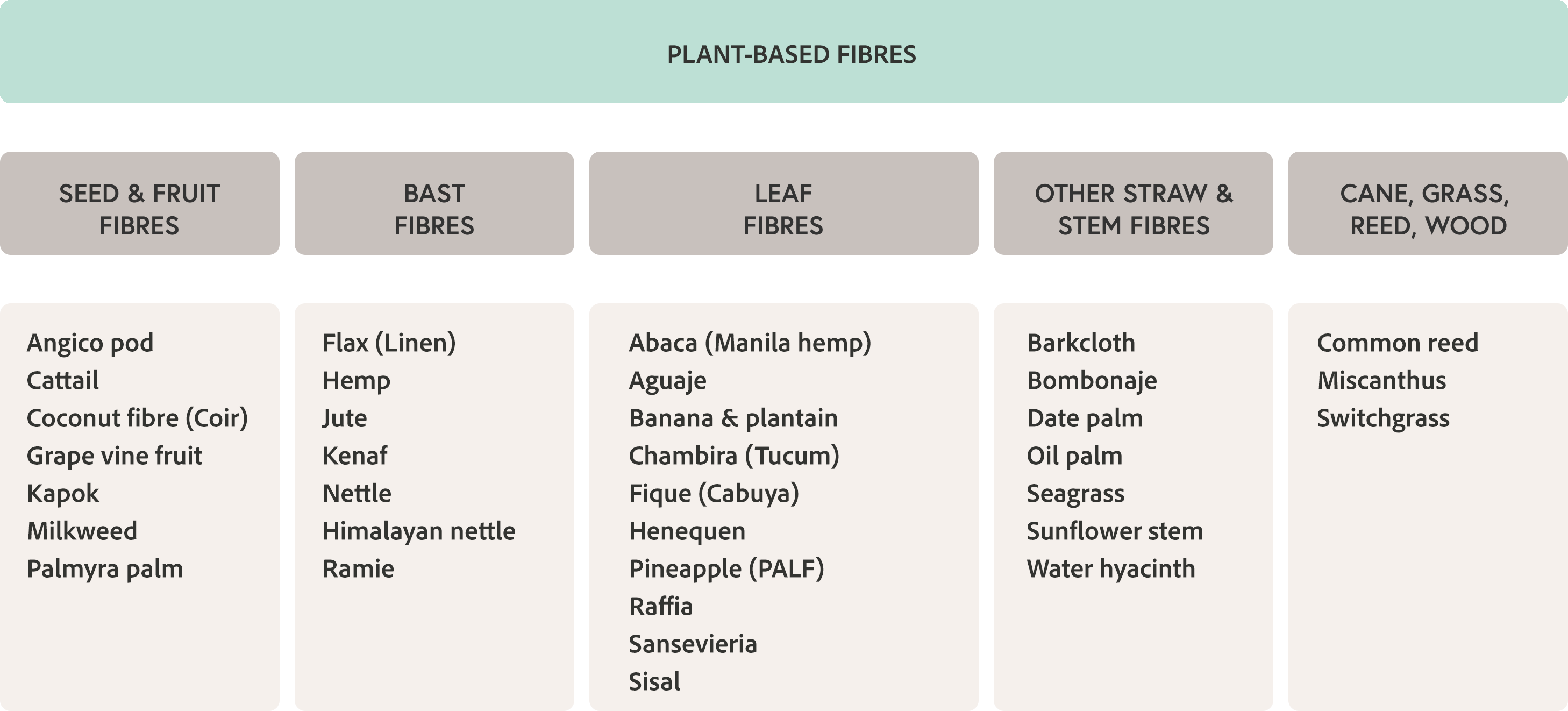
Plant fibres can be derived from different parts of plants—including stems, leaves, seeds, and empty fruit bunches—and are often classified either by the plant part they originate from (see table below) or by their source, i.e. dedicated fibre crops, agricultural residues, wild plants, invasive species, and other biomass crops.
FIBRAL focuses on natural fibre extraction and innovations in this field. These processes may involve mechanical, biological, thermal, or chemical treatments, such as retting, decortication, degumming, or cottonisation. In addition to their direct use as natural fibres, plant fibres can also serve as feedstock for man-made cellulosics as well as for emerging biosynthetic materials.
Impact
NATURE-BASED SOLUTION AND CONTRIBUTOR TO RURAL DEVELOPMENT
When cultivated in line with environmental restoration goals, plant fibres offer strong potential as nature-based solutions and drivers of livelihood and economic development. Recognized by the UN Resolution on natural plant fibres, their low-impact, climate-resilient production can reduce environmental degradation and greenhouse gas emissions while supporting biodiversity.
Integrated into regenerative agricultural systems, plant fibres can enhance land restoration and ecosystem resilience, while simultaneously creating employment—particularly for women and smallholder farmers—strengthening rural development and food security, and contributing to long-term economic resilience.

ENVIRONMENTAL & CLIMATE RESILIENCE
● Enhancing biodiversity and soil health through regenerative agriculture
● Replenishing marginal lands
● Utilising agricultural waste to reduce harmful waste management practices
● Controlling infestations
● Rewetting peatlands

RENEWABLE & CIRCULAR MATERIAL SYSTEMS
● Renewable raw materials
● Biodegradable
● Multipurpose use of all parts of the plant
● Extraction waste can be repurposed in biorefinery approach

SOCIAL IMPACT & RURAL LIVELIHOODS
● Fostering rural development
● Preserving culture and heritage
● Creating livelihoods for small producers